What Is Ham Radio? A Plain-Language Introduction
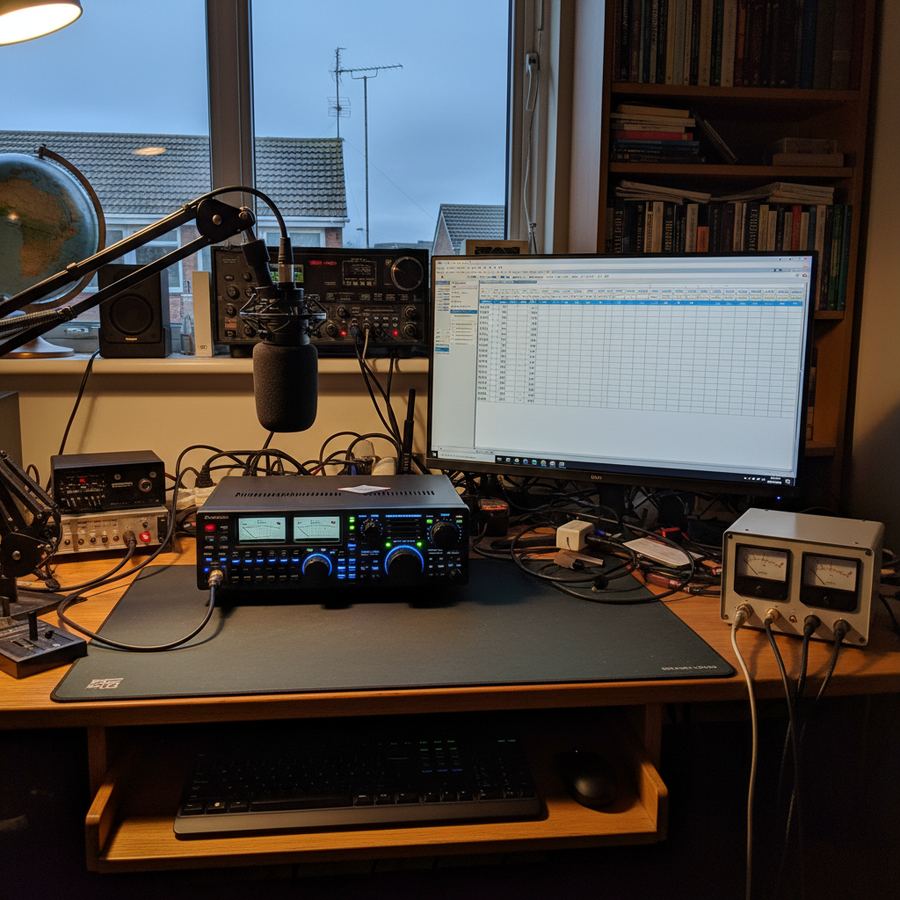
Ham radio, formally called amateur radio, is a licensed radio service that lets individuals communicate using designated radio frequencies. Unlike commercial broadcasting or cellular networks, ham radio is non-commercial and operated by private citizens who have passed a government exam. There are roughly three million licensed amateur radio operators worldwide, and the hobby has been active since the early 1900s.
The name "ham" has murky origins. Some trace it to early amateur operators being called "hams" (as in ham-fisted) by professional telegraph operators. Others point to a 1908 station using the callsign HAM. Whatever the source, the name stuck. Today it just means amateur radio.
What Do Ham Operators Actually Do?
The range of activity is wide. On any given evening, you might find operators:
- Having voice conversations (called ragchewing) on HF frequencies with people hundreds or thousands of kilometres away
- Checking into a local net on a VHF repeater to share news and stay in touch with their radio club
- Competing in contests where the goal is to make as many contacts as possible in a set time period
- Experimenting with digital modes like FT8, where computers encode and decode weak signals that a human ear could never pick out of the noise
- Tracking their position and sending short messages using APRS
- Bouncing signals off the moon, through amateur satellites, or via the ionosphere to reach distant stations
- Providing emergency communications when other systems fail
There is no single way to be a ham. Some operators focus entirely on building antennas and homebrewing equipment. Others are primarily interested in contesting or collecting contacts from every country on Earth (called working toward DXCC). Some just like having a reliable way to talk to friends without depending on internet or cell infrastructure.
Who Gets Into This?
The stereotype of the old man in a basement shack with a tower in the backyard still exists, but the reality is more varied than it used to be. The hobby attracts people of all ages and backgrounds. Engineers and electricians take to it naturally, but plenty of operators come from non-technical fields and learn as they go. Student radio clubs exist at universities. Scouting groups use ham radio as a way to teach communications skills. In rural areas, ham radio provides a communications backup that does not depend on cell coverage.
The common thread is curiosity. If you are the kind of person who wonders how signals travel, why you can hear a distant AM station at night but not during the day, or what it would take to talk to someone in Australia using equipment you built yourself, ham radio will hold your attention for a long time.
How Licensing Works in Canada
In Canada, amateur radio is regulated by Innovation, Science and Economic Development Canada (ISED), the federal department responsible for spectrum management. To operate a ham radio station, you need an amateur radio operator certificate.
There are two qualification levels:
- Basic Qualification: This is the entry-level licence. The exam covers basic electronics, regulations, safety, and operating procedures. It has 100 multiple-choice questions, and you need to score at least 70% to pass. With a Basic qualification, you can operate on VHF and UHF frequencies and, if you score 80% or higher, you also get HF privileges. Most new operators study for a few weeks to a couple of months before taking the exam.
- Advanced Qualification: This adds a 50-question exam on more advanced technical topics. Passing it lets you build your own transmitting equipment and operate at higher power levels. It is not required, but many operators pursue it over time.
Exams are administered by accredited examiners, often through local radio clubs. Radio Amateurs of Canada (RAC) maintains study resources and can help you find an examiner in your area. There is no age requirement for the licence, and the certificate does not expire as long as you keep your address current with ISED.
Once you pass, ISED assigns you a callsign. Canadian callsigns start with VA or VE followed by a number indicating your province or territory, then your unique suffix. That callsign becomes your on-air identity.
What Gear Do You Need?
You can get started with remarkably little equipment. A handheld VHF/UHF radio (often called an HT, for handy-talkie) costs between $30 and $300 depending on features. With it, you can access local repeaters and talk to other operators in your area. Our guide to choosing your first handheld covers the practical details.
For HF, which is where long-distance communication happens, a basic transceiver starts around $500 used and goes up from there. You also need an antenna, which can be as simple as a wire strung between two trees. Many hams run effective HF stations for well under $1,000 total.
The point is that you do not need a lot of money to start. You need a licence, a radio, and an antenna. Everything else is optional and can be added as your interests develop.
Why Bother When We Have the Internet?
This is the question every ham gets asked. The answer depends on who you ask, but a few themes come up consistently.
First, ham radio works when nothing else does. It requires no cell towers, no internet service provider, no power grid if you have a battery. In ice storms, floods, and other emergencies, ham operators are often the first to establish communications.
Second, there is genuine satisfaction in making a contact using equipment you understand from the ground up. When you talk to someone 5,000 km away using a radio and an antenna you put together yourself, you understand exactly how that signal got there. No black boxes, no algorithms, no terms of service.
Third, it is deeply social. Ham radio has a culture of helping, mentoring, and sharing knowledge that predates the internet by decades. The radio culture of nets, clubs, Field Day, and on-air friendships is something you do not find in many other hobbies.
If any of that sounds interesting, start studying. The exam is more approachable than most people expect, and the hobby on the other side of it is worth the effort.